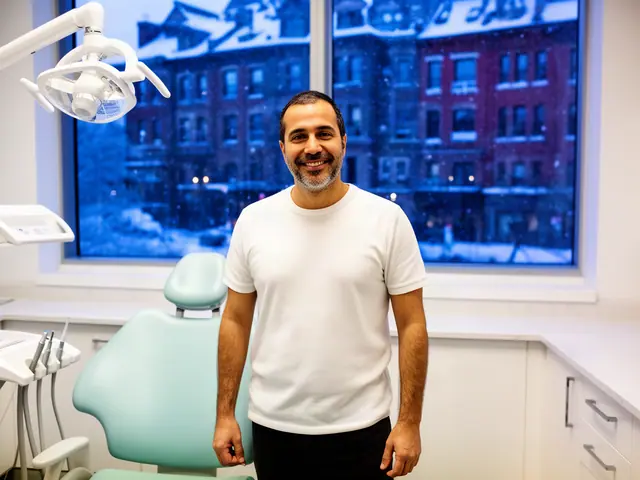
This article from Harbordale Lending Group in Bay City, Michigan explains what dental practice loans pay for, why no page can quote a rate, and what a Bay County dentist gathers before applying.
Dental Practice Acquisition Loans for a Bay County, MI Office Changing Hands
Buying a dental practice means paying for its equipment, patient records, goodwill and often the lease or building. Lenders financing an acquisition read the practice's collections and expenses for several years, the patient count, the equipment list and the transition plan. A term loan is the usual structure, sometimes alongside a seller note.
A dentist buying in to an existing practice faces the same review on a smaller share. The price, the share and the timing are set in the purchase or partnership agreement.
Dental Office Loan Rates: Why No Page Can Quote One for a Bay City, MI Operatory
Dental office loan rates depend on the lender, the loan type, the term, the collateral, the practice's finances and the dentist's credit, and they change with market rates. A rate quoted on a web page without those facts would be a guess. Offers from funding partners state the actual rate and fees after review.
Compare offers on the total paid over the life of the loan, not the rate alone, because fees and terms change the total.
What Bay County, MI Numbers Say About Dental Office Size and Payroll
Bay County, MI had 32 offices of dentists with paid employees in 2023, with 291 paid employees and $15.7 million in annual payroll (County Business Patterns). That averages about 9 employees and about $491,700 in payroll per office (our arithmetic), the scale of a typical small practice team.
Eleven of the 32 offices had a ZIP 48708 address (ZIP Business Patterns 2023). Nonemployer Statistics separately counted 6 dental businesses with no payroll in the county for 2024.
Operatory Build-Outs, Imaging and Sterilization: What Each Costs to Fund
An operatory includes the chair, delivery unit, light, cabinetry, plumbing, electrical and air and vacuum lines. Imaging ranges from intraoral sensors to panoramic units and CBCT scanners. Sterilization brings autoclaves, ultrasonic cleaners and a sterilization center. Lenders treat movable equipment and built-in improvements differently:
- Chairs, delivery units, imaging and autoclaves: equipment loans or leases, with the equipment as collateral.
- Cabinetry, plumbing, wiring and walls: leasehold improvements, usually funded with a term loan.
- Software and service contracts: ongoing costs, often outside equipment financing.
Working Capital for a Dental Office in the Months After a Transition
After a transition, patients and staff take time to settle, and collections can dip while the new owner builds trust. Working capital, as a short loan or a credit line, covers payroll, lab bills and supplies during those months. Lenders look at the practice's historical collections and the transition plan when sizing it.
Plan the working capital alongside the purchase loan rather than after closing. A seller who stays on as an associate for a period after the sale can steady both patients and collections, and lenders may ask whether the agreement provides for that. If the seller carries part of the price as a note, the lender will want to know when that note is paid and how it ranks against the bank loan.
An Invented Expansion Example for a Bay County, MI Dental Office
Illustration only, invented figures: a Bay County, MI dental office adds two operatories and a CBCT scanner for an invented $165,000, financed at an invented annual rate of 9% over 84 months. The monthly payment is about $2,655, and the payments total about $222,995 (our arithmetic).
If the invented expansion adds $5,500 a month in collections after supplies and lab costs, it covers the invented payment with about $2,845 a month to spare (our arithmetic). The real test is the office's own schedule and case mix. An office with a waiting list for hygiene appointments fills new chairs sooner than one that already has open time, and a funding partner may ask for appointment and production reports to see which describes the practice.
Records a Bay County, MI Dentist Pulls Together Before Applying
- Three years of practice tax returns and financial statements.
- Collections and production reports.
- Equipment quotes and the build-out bid.
- For an acquisition: the purchase agreement, the seller's records and the lease.
- The dentist's own tax returns and a personal financial statement listing assets and debts.
The dental office loans page covers equipment and transitions in more detail, and the Bay City, MI page lists dental and other office counts by ZIP.
By Harbordale Lending Group · Updated